
Damp & Water Ingress Repairs in Falkirk & Central Scotland
Damp patch high up a wall, or staining that gets worse when it rains? That’s not rising damp — it’s water getting in from above. We find the source and fix it.
Get my free quote
Leave three details and we’ll ring you back.
Free, no-obligation survey · Written quote · 10-year guarantee
Open Mon–Sat 9am–5pm
Rated 5 stars by local homeowners
Don’t just take our word for it — see our reviews across Google, Facebook and MyBuilder.
10-Year Guarantee
On all our workmanship
25+ Years
Experience in the trade
Family-Run
A local business you can trust
Damp and water ingress repairs in Falkirk — guide prices
Water ingress is priced on the cause, not on the size of the stain, so the honest answer to what it costs is that it depends entirely on what we find. These are realistic 2026 ranges for the repairs that most commonly turn out to be the source.
| Job | Typical guide price | What affects it |
|---|---|---|
| Damp survey, loft inspection and leak trace | Free with a quote | A long-standing or intermittent leak may need a second visit in wet weather to confirm |
| Clear gutters and re-seal leaking joints | £80–£250 | Length of run, height, how much moss and debris has to come out |
| Replace slipped, cracked or missing slates | £150–£400 | Number of slates, matching reclaimed stock, ladder or tower access |
| Re-dress or renew lead flashing at an abutment or chimney | £350–£900 | Stepped or straight detail, condition of the back gutter, scaffold |
| Renew a failed valley | £600–£1,500 | Length of the valley, lead or GRP, how many slates have to be lifted |
| Chimney repointing or flaunching where the stack is the source | £300–£800 | Stack height and size, mortar type, access |
| Repair cracked or blown roughcast and make good | £250–£900 | Size of the patch, matching the existing finish, whether the whole elevation needs it |
| Internal making-good after drying, one wall | £400–£900 | Whether blown and salt-contaminated plaster has to come off, decoration |
Guide prices only, for typical Falkirk properties. We diagnose the actual cause first and then confirm a fixed written price after a free, no-obligation survey, and all workmanship carries our 10-year guarantee.
Show my Falkirk guide price
Pick the job and the guide range from the table above appears straight away. Leave your details and we’ll ring to book the free survey, then you get a fixed written quote — the guide range is a starting point, not the final price.
What our customers say


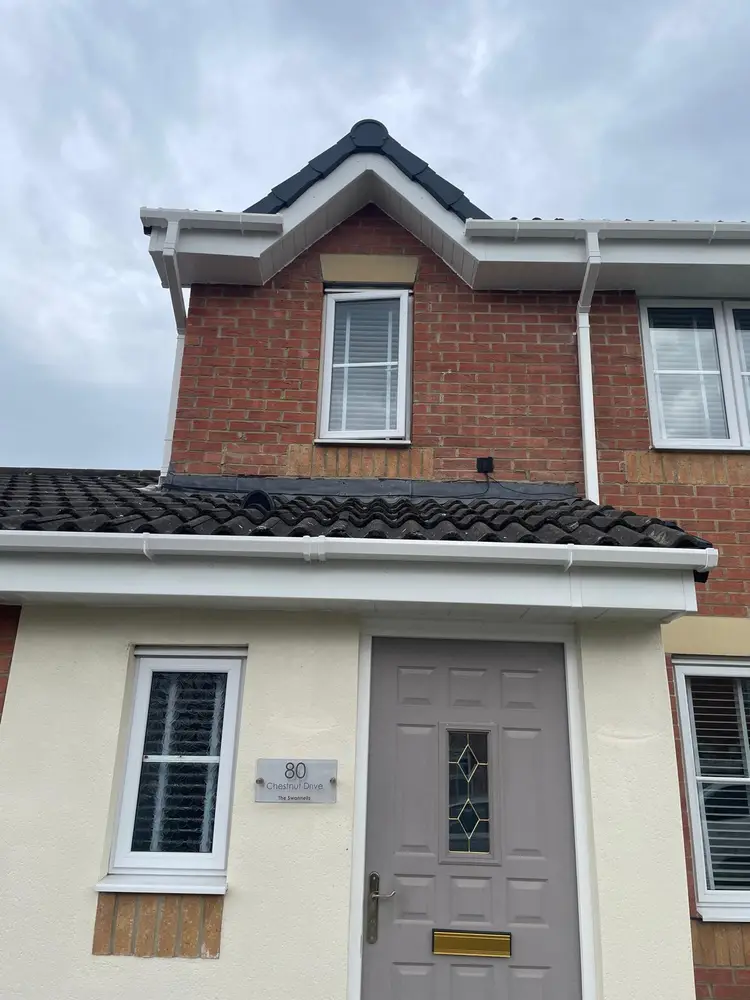
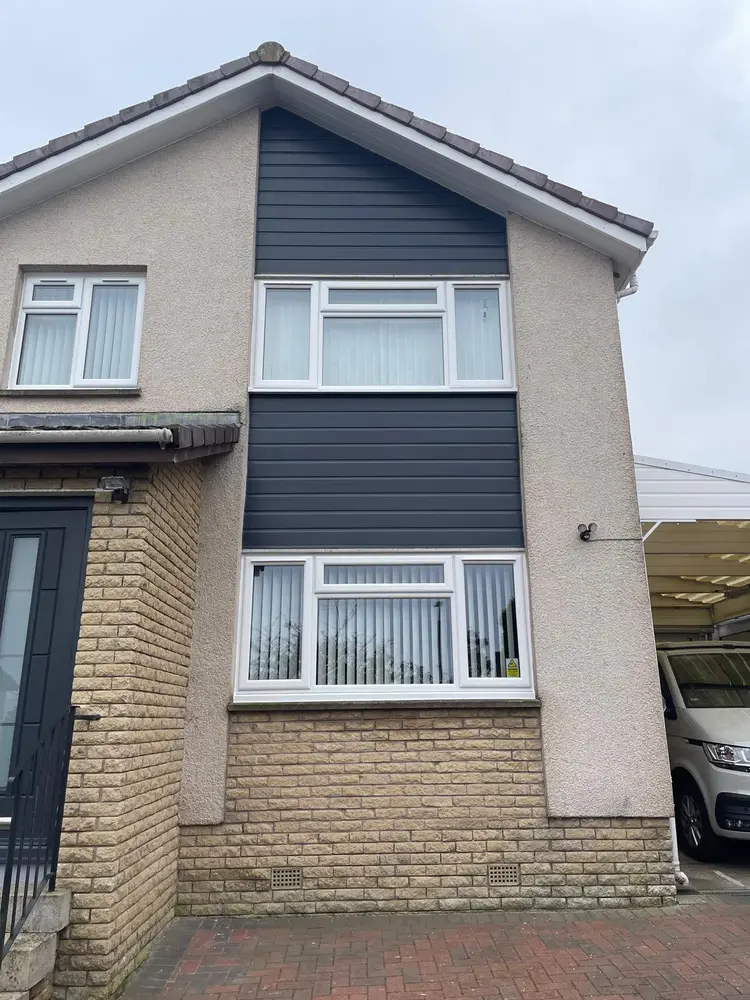
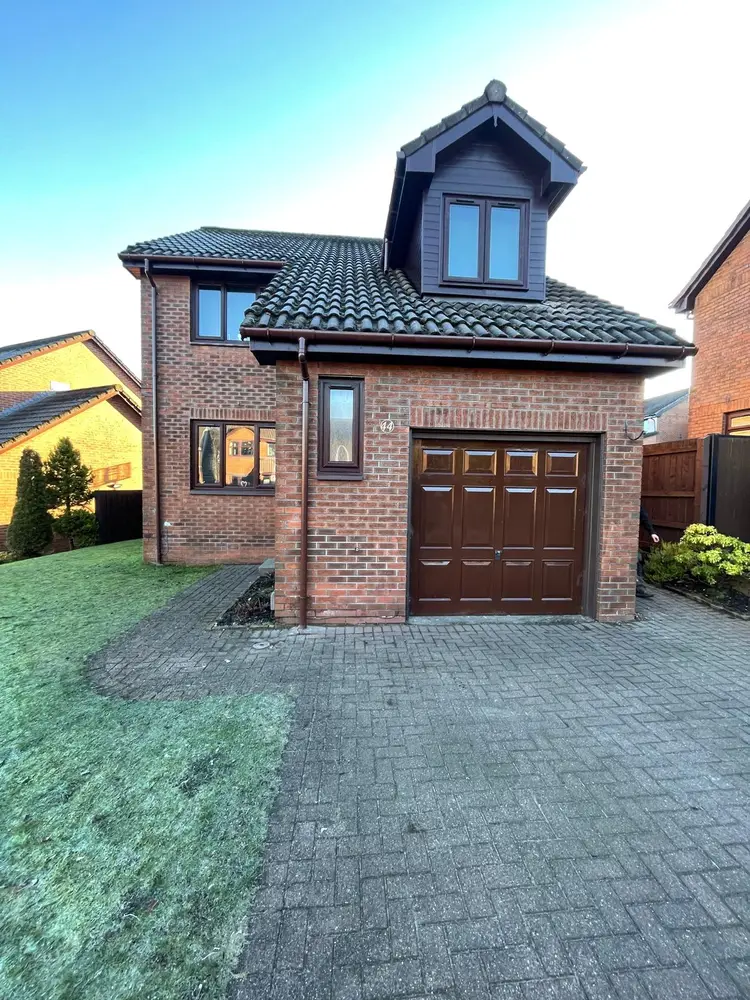
Recent F J Allan jobs across Falkirk and Central Scotland
Real jobs by our own team. Ask to see more from your area when we survey.
Damp & Water Ingress Repairs in Falkirk & Central Scotland
Here’s something most homeowners don’t realise: a damp patch high up a wall or upstairs is almost never rising damp — rising damp rarely climbs above a metre. Staining that high is penetrating damp, where water is getting in from a fault above it — a leaking gutter, failed flashing, slipped tile or cracked pointing. F J Allan & Sons trace it to the true source and fix the cause across Falkirk, Stirling, the Forth Valley and North Lanarkshire.
Treating the inside alone never works — the wall just keeps getting re-wetted every time it rains. As roofers, we fix what’s actually letting the water in.
Where the water is really getting in
We follow the water back to its source — not just paint over the symptom.
Leaking gutters & downpipes
Overflowing or split gutters run water straight down the wall — the single most common cause of damp above ground level.
Failed flashing & valleys
Cracked lead around chimneys, dormers and roof junctions, or a failed valley, lets water track inside after every shower.
Slipped tiles & failed pointing
A single slipped slate or cracked pointing gives water a path in that shows up as a stain some distance away.
Chimney & parapet defects
Cracked flaunching, spalled brick and porous parapets soak up water and carry it down into the rooms below.
Signs it’s penetrating damp, not rising damp
It’s above a metre / upstairs
Rising damp rarely goes above skirting height. Staining higher up almost always comes from above.
It’s worse after rain
If the patch darkens or spreads when it rains and dries between, that points to an external water source.
Brown tide-marks & blistering
Tea-coloured stains, blistering paint and crumbling plaster in a defined patch are classic penetrating-damp signs.
It lines up with a route
There’s usually a plausible path above — a gutter joint, downpipe, valley, chimney or cracked render.
Why choose F J Allan?
Damp-proofing firms will happily inject and re-plaster the inside — but if the water is coming from your roof or gutters, it comes straight back. We’re qualified roofers: we find the real external cause, fix it properly, and stop the damp at source. Honest diagnosis, clear fixed prices, 10-year workmanship guarantee, 25+ years’ experience.
What affects the cost of fixing water ingress?
It depends entirely on the cause:
- The source — a gutter re-seal is quick; failed flashing or chimney work is more involved.
- Access — ground-floor gutter vs a three-storey chimney.
- How long it’s been leaking — and whether any timber or plaster now needs attention.
We diagnose the true cause first, then give you a clear fixed price — no guesswork, no re-wetting walls.
Areas we cover
We cover Falkirk and within about 20 miles — Falkirk, Grangemouth, Larbert, Stenhousemuir, Bonnybridge, Denny, Bo’ness, Polmont, Linlithgow, Stirling, Dunblane, Cumbernauld, Kilsyth, Airdrie, Coatbridge, Bathgate, Livingston and Alloa. Also see our roof repairs and conservatory roof replacement services.
Damp & water ingress repairs across the Forth Valley
We also cover the surrounding towns — find your local page: Grangemouth · Larbert · Stirling · Cumbernauld · Airdrie · Coatbridge · Kilsyth · Bo’ness · Linlithgow · Bathgate · Alloa · Bonnybridge · Denny · Polmont · Dunblane · Livingston.
More about damp and water ingress in Falkirk
Open any heading for the detail: what we do here, local roof types, prices, how to check a roofer, and storm claims.
Damp and water ingress in Falkirk: three problems, one name
Nearly every call we take about damp and water ingress in Falkirk turns out to be one of three separate things, and telling them apart is most of the job. Get it wrong and you can spend four figures on the wrong trade and still have a wet wall.
Condensation is the most common and the most often misdiagnosed. It shows as black spotted mould rather than a brown stain, and appears where surfaces are coldest: window reveals, the corners of external walls, behind wardrobes, in bathrooms. It is worst in winter and on cold mornings, has no relationship to whether it rained yesterday, and spreads diffusely rather than forming a defined patch. The cause is household moisture meeting a cold surface, so the fix is ventilation, heating and insulation — not roofing, and we will tell you so.
Penetrating damp is water coming through the fabric from outside. It makes a defined patch with a tea-coloured tide line, gets visibly worse during and after heavy rain and dries back between spells, and often appears at first-floor level or high on a wall. It can be metres from the actual defect, because water runs along a rafter, a purlin or the back of the render before it finds a way through the plaster.
Rising damp is groundwater drawn up through masonry. It is genuinely uncommon and limited by physics to roughly the first metre above ground — you will not find it upstairs. Where a ground-floor wall really is wet, the cause is far more often a bridged damp-proof course, ground built up above the DPC, or a leaking downpipe. Our post on a damp patch high on a wall that is not rising damp works through the same reasoning.
Where the water gets in on Falkirk houses
Once we have established it is coming from outside, the list of realistic culprits is short. Roughly in the order we find them:
- Gutters and downpipes. A blocked or split rhone spills water down the same strip of wall every time it rains, and that wall soon carries permanent moisture. The most common external cause, and often the cheapest to fix — see guttering in Falkirk and how blocked and leaking gutters cause damp.
- Flashings and valleys. Cracked cement fillets where a roof meets a wall, split lead at an abutment, a failed valley, or a back gutter behind a chimney. These leak into the roof space and only show inside once the ceiling has taken enough water.
- Slipped, cracked or missing slates. One displaced slate is enough. On older roofs with no underfelt, anything past the covering goes straight onto the sarking.
- The chimney. Cracked flaunching, perished pointing, a disused flue sealed without ventilation, or spalled brick carrying water down inside the stack — see chimney repairs in Falkirk.
- Cracked or blown roughcast. Many Falkirk houses are roughcast, and plenty are solid stone with no cavity, so nothing stops water once it is through the render. A hairline crack passes water in wind-driven rain while staying dry in drizzle — see rendering and roughcasting in Falkirk.
- Parapets and flat-roof upstands. Porous cope stones and shallow upstands let water sit and soak in.
Exposure matters too. Forth Valley weather comes mainly from the west and south-west, so that elevation takes the most wind-driven rain and is usually the one with the damp.
How we actually find it
Guessing is what produces repeat visits, so we work through it methodically.
- Look inside first. The height, shape and edge of the stain tell us a lot before we go near a ladder. We take moisture readings across and up the wall, and we are honest about a meter’s limits: a pin meter reads salts as damp, so a reading is a clue, not a verdict.
- Get into the loft, ideally during or just after rain. Water tracks show on sarking, rafters and purlins as dark staining or drips, and following them uphill usually points straight at the defect.
- Inspect outside from the top down — chimney, ridge, slopes, valleys, flashings, gutters, render, sills, then ground levels.
- Hose test where it is not obvious. One zone at a time, starting at the lowest point and working up, ten to twenty minutes each, with someone inside watching. Starting low is what makes the result meaningful; soak the whole elevation at once and you learn nothing.
Two honest caveats: a long-standing leak sometimes needs a second visit in wet weather to confirm, and a wall wet for years occasionally has two faults rather than one. Either way we photograph what we find. If it is a ceiling stain rather than a wall, our post on what causes a brown water stain on a ceiling covers the usual routes.
Why treating the inside on its own never works
Where a damp-proofing survey recommends a chemical injected damp-proof course and re-plastering in waterproof render, it is worth pausing on two things. First, an injected DPC only ever addresses rising damp, so if your stain is above a metre or upstairs it cannot be the answer. Second, tanking and waterproof render do not stop water arriving — they hide it. The wall keeps getting re-wetted from outside, the moisture moves sideways and upwards to find an escape, and it reappears above the treated band a year or two later.
The long guarantees attached to that work are worth reading closely. They typically cover the reappearance of rising damp specifically, which is not the same as covering a wet wall.
None of which makes damp-proofing firms dishonest, and there are real cases of rising damp where the treatment is right. The point is that the survey has to start outside and above. A fair test is to ask whoever surveys your house what is directly above the stain, and whether they have checked it.
Drying out and putting it right inside
Fixing the leak is the first half. Masonry that has been wet a long time holds a great deal of water, and it does not disappear the day the roof is repaired. A rough trade rule is around a month per 25mm of wall thickness in reasonable conditions, so a solid stone wall can take several months and a plastered internal wall a good few weeks.
What speeds it up is gentle background heat and steady ventilation together; heat without ventilation just moves moisture into the next room. What slows it down is re-plastering or repainting too early — seal a wet wall behind new plaster and you trap the moisture, and the finish blisters within the year.
Some internal repairs cannot wait. Plaster that has blown and sounds hollow has lost its key and has to come off regardless. Where a wall has been wet for years, hygroscopic salts left in the plaster keep drawing moisture from the air and keep the surface looking damp even after the wall is dry, so that plaster needs replacing rather than drying. Once the cause is fixed and the wall has dried, making good is ordinary plastering, and we will say plainly when it is ready.
Flats, tenements and shared causes
If you are in a flat and the damp comes from the roof, the gutters or a common gable, the repair is unlikely to be yours alone to organise. Under the Tenements (Scotland) Act 2004, the roof, the rhones and the structure serving more than one flat are normally scheme property. A majority of the flats can agree a repair — one vote each — and the cost is usually shared equally unless the deeds say otherwise. A top-floor flat taking the water is not automatically the flat that pays.
In practice the obstacle is rarely the law and usually the evidence: neighbours who cannot see the fault will not commit to a share of an unknown bill. What breaks the deadlock is a written report with photographs of the defect and a fixed price broken down per flat. We provide that as a matter of course, and it is the same document that works for an insurance claim.
On insurance, a sudden failure or storm damage is normally covered less the excess, while gradual deterioration is excluded on almost every buildings policy — which is why a leak quietly running for three winters is often turned down. Damage to contents and decoration may still be covered even where the roof repair itself is not, so it is worth asking. If the cause was a storm, our roof repairs in Falkirk page explains the report side of a claim.
Damp & water ingress FAQs
Is my damp patch rising damp or a roof leak?
If it’s above a metre, upstairs, or gets worse after rain, it’s almost certainly penetrating damp from above — a roof, flashing or gutter fault — not rising damp.
Why hasn’t treating the inside worked?
Because the water is still getting in from outside. Injecting or re-plastering the inside can’t stop rain entering through a failed gutter or flashing — the wall just re-wets.
Will my insurance cover it?
Often, if a storm or sudden failure caused it. We can provide a report and photos of the defect for your claim.
How do you find where the water’s getting in?
We inspect the roof, flashings, valleys, chimney and gutters, follow the ‘plausible route’ above the stain, and confirm the source before we quote.
Do you repair the damage inside too?
We fix the external cause so it can’t come back. Once the wall has dried out, internal making-good is straightforward and we can advise on it.
How can I tell condensation from penetrating damp?
Condensation makes black spotted mould on the coldest surfaces — window reveals, wall corners, behind furniture — is worst in winter and on cold mornings, and has no relationship to rainfall. Penetrating damp makes a defined patch with a brown tide line, gets worse during and after heavy rain, and dries back between spells. If your problem is mould in corners rather than a stain that comes and goes with the weather, the answer is ventilation and heating, and we will say so rather than sell you roofing.
Why does my damp patch only appear in certain storms?
Almost always wind-driven rain on one elevation. In the Forth Valley the weather comes mainly from the west and south-west, and rain driven horizontally at a wall behaves completely differently from rain falling on it. A hairline crack in roughcast, a shallow flashing upstand or a gap round a sill can stay watertight in ordinary drizzle and pass water freely in a gale from the wrong direction. It is a strong clue about which wall to test, and why a dry-weather inspection can miss the fault.
How long will my wall take to dry out after you fix the leak?
Longer than most people expect. A working rule is about a month per 25mm of wall thickness in reasonable conditions, so a plastered internal wall takes several weeks and a solid stone wall can take months. Gentle background heat plus steady ventilation is what dries it, and a dehumidifier in a closed room helps a lot. Do not re-plaster or repaint too early, because sealing a wet wall traps the moisture and the new finish blisters within the year.
Do I need a damp-proof course installed?
Probably not. True rising damp is uncommon and cannot climb much above a metre, so anything upstairs or high on a wall is not it. Where a ground-floor wall genuinely is wet, the cause is more often a bridged damp-proof course, a path or garden built up above DPC level, or a leaking downpipe soaking the wall outside. An injected DPC only addresses rising damp, so if that is not your problem it cannot fix it. Get the outside checked before committing to injection and re-plastering.
Who pays if the damp comes from a shared roof or gutter?
Normally all the flats. Under the Tenements (Scotland) Act 2004 the roof and rhones serving more than one flat are usually scheme property, so a majority of owners can agree the repair and the cost is generally shared equally unless the title deeds say otherwise. The top-floor flat suffering the damp does not automatically foot the bill. We give you one written report with photographs and a fixed price broken down per flat, which is usually what gets neighbours or a factor to act.
Can you give me a report for my insurer or my factor?
Yes, and we do it as standard. You get photographs of the actual defect, a plain description of the cause and what it damaged, and a fixed written price for the permanent repair. That is the document an insurer needs to assess a storm or sudden-failure claim, and the one a factor or a group of owners needs to agree a common repair. Bear in mind insurers cover sudden damage rather than gradual deterioration, so the cause of the leak is what a claim turns on.
Damp & Water Ingress across the whole Forth Valley
We provide damp and water-ingress repairs in Falkirk, Grangemouth, Larbert, Stirling, Cumbernauld, Airdrie, Coatbridge, Kilsyth, Bo’ness, Linlithgow, Bathgate, Alloa, Bonnybridge, Denny, Polmont, Dunblane and Livingston, and right across Central Scotland. Wherever you are in the Forth Valley, you get the same qualified, family-run team, the same 10-year workmanship guarantee, and a clear fixed price after a free survey. See every town on our Areas We Cover page.