
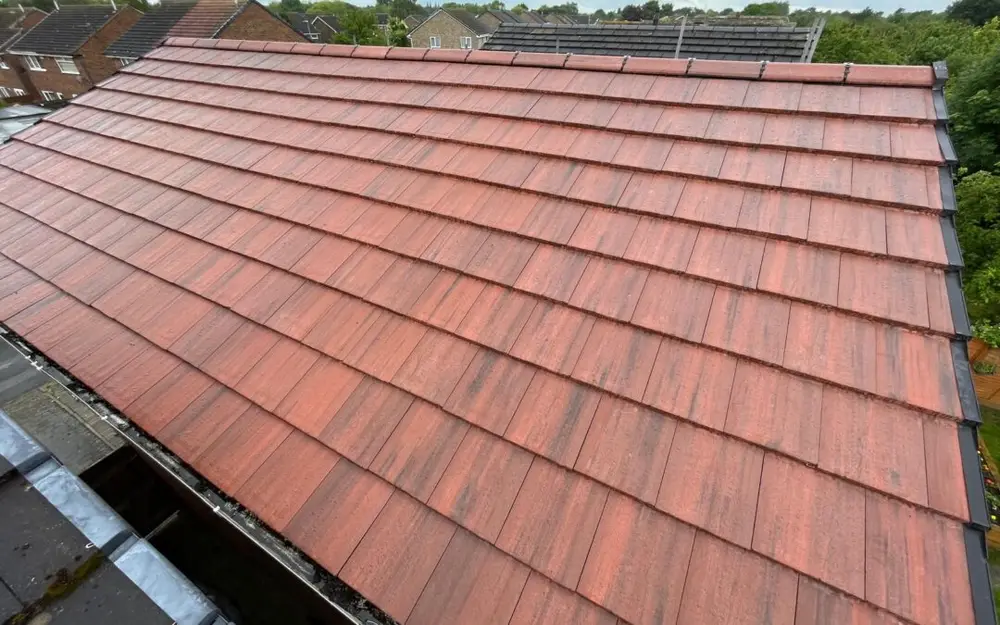
A new roof is a big investment, so it pays to understand what drives the cost. Here is an honest guide for homeowners in the Falkirk and Forth Valley area, with realistic figures rather than teaser prices.
How much does a new roof cost in Scotland?
For most Scottish homes, a full re-roof lands somewhere between £4,500 and £15,000. As a rule of thumb, a typical three-bed semi re-roofed in concrete tile usually comes in around £4,500–£9,000, while natural slate runs from about £8,000 upwards.
| Property type | Concrete tile | Natural slate |
|---|---|---|
| 2-bed terraced house | £4,000–£7,000 | £7,000–£11,000 |
| 3-bed semi-detached | £4,500–£9,000 | £8,000–£15,000 |
| 3-bed bungalow | £5,000–£9,500 | £8,500–£15,000 |
| 4-bed detached | £7,500–£13,000 | £12,000–£18,000+ |
These are guide prices only, drawn from current UK and Scottish trade cost guides and what we see across Central Scotland — roughly £100–£250 per square metre for a full re-roof, depending on the covering. A proper figure includes scaffolding, stripping the old roof, disposal, new underlay and battens, not just the tiles. Every roof is different, so the only reliable number is a fixed written quote after a free survey.
Bungalows sometimes surprise people: a single-storey house can have a bigger roof footprint than a two-storey one, so the roof itself can cost as much or more even though the scaffolding is simpler.
What affects the price of a re-roof?
Size, material and access do most of the work in setting the price — and what’s found under the old covering does the rest.
- Size and pitch of the roof — more area means more materials and labour; steep pitches are slower and need more access equipment.
- Material — concrete tile, clay tile or natural slate all cost differently (slate is the most expensive to buy and the most skilled to fit).
- Access and scaffolding — a tricky or tall roof costs more to work on safely; scaffolding alone commonly runs into the high hundreds per week on national guides.
- Removing the old roof and disposing of it — stripping and skips are a real chunk of the job.
- Extras — new flashings, ridge, ventilation and any timber repairs found once the old covering comes off.
What does a full re-roof include?
A good re-roof is not just new tiles — it’s a complete new roof system from the timbers up. If a quote only mentions the tiles, it isn’t comparing like with like.
It should include a new breathable underlay, new battens, proper ventilation, and new ridge and flashings — so the whole system lasts for decades, not just the surface. This is where cheap quotes cut corners: reusing tired battens or skipping ventilation saves money on day one and causes condensation and rot problems for years afterwards.
Why are Scottish roofs different?
Two reasons: how they’re built, and what they have to survive. Most older Scottish roofs are built on solid timber sarking boards beneath the slates or tiles — a stronger construction than the open-batten roofs common in England — and our weather works roofs harder all year round.
Sarking is good news for strength in high winds, but when we strip a roof we sometimes find boards that need replacing, which is why a survey matters before a price is fixed. On top of that, Central Scotland’s wind-driven rain and freeze-thaw winters punish weak flashings and tired coverings faster than a sheltered southern roof would ever experience — so materials and detailing rated for exposure are worth paying for. A like-for-like re-roof generally doesn’t need a building warrant in Scotland, but changing to a significantly different covering can do — we’ll advise on your specific job and check with the council where needed.
Concrete tile, clay or slate — which should you choose?
Concrete tile is the best-value all-rounder; clay costs more but holds its colour; natural slate is the traditional Scottish covering with the longest life. Concrete tiles typically give decades of service, while a well-fixed natural slate roof can outlast everyone reading this page — which is why slate costs more up front but can be the cheapest roof per year of life. In conservation areas, slate may effectively be the required choice; we can advise on that at survey.
How do you get an accurate figure?
Because every roof is different, the only reliable way to know the cost is a free survey and a written, fixed quote — no vague “from” prices. A ten-minute look at the roof, the access and the timbers tells us more than any online calculator, and it costs you nothing.
Frequently asked questions
How long does a re-roof take?
Typically around a week on site for an average semi, weather permitting — larger or more complex roofs take longer. We’ll give you a realistic timescale with the quote.
Can you put new tiles over the old ones?
No — the old covering has to come off. The roof needs new underlay and battens to perform properly, and the structure has to be checked for the weight of the new covering.
Does a new roof need a building warrant in Scotland?
Usually not for a like-for-like replacement, but it can if you change the covering or alter the structure. We’ll tell you at survey and handle any paperwork that’s needed.
Is it cheaper to repair than replace?
Often, yes — if the roof is fundamentally sound. We’ll always tell you if a repair will honestly do the job; a re-roof is only worth it when patching has become a false economy.
Wondering what a re-roof would cost you? Call 01236 338876 for a free, no-obligation survey and a clear fixed price, or read more about our tiled roofing in Falkirk and slate roofing services.