
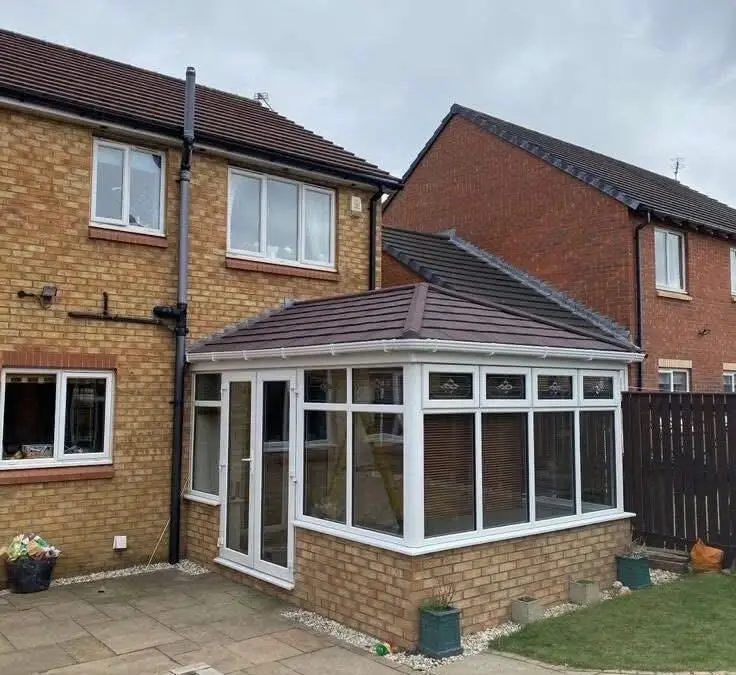
If your conservatory roof is past its best, you have three main choices: polycarbonate, glass, or a warm (solid) tiled roof. Here is how they really compare for a Scottish home.
Which conservatory roof is best: warm tiled, glass or polycarbonate?
For a conservatory you actually want to use all year in Scotland, a warm tiled roof is the strongest choice; glass is a good middle ground if maximum light matters most, and polycarbonate is really a budget, shorter-term option. The right answer depends on how you use the room, so here’s each option honestly.
How does a polycarbonate roof perform?
Polycarbonate is the cheapest option and what most older conservatories have — but it’s the main reason so many conservatories are too hot in summer and freezing in winter.
It is light and lets in plenty of light, but it offers almost no insulation, it’s noisy in the rain, and it looks dated. Over the years the panels discolour and the room underneath becomes a greenhouse in July and a fridge in January. If your conservatory currently sits unused for half the year, the polycarbonate roof is almost certainly why. As a replacement choice today, it only really makes sense as a short-term, lowest-cost fix.
Is a glass conservatory roof any good?
A modern glass roof is a big step up from polycarbonate — but it’s also the most expensive option, and it still lets a lot of heat in and out.
Modern self-cleaning, solar-control glass looks smart and cuts glare and heat compared with poly. If keeping a fully glazed ceiling matters to you — for the sky, the light, the feel — glass is the way to do it well. The trade-offs are cost (high-spec glazing units are typically the dearest of the three per square metre on current national guides), glare on bright days, and the physics of glass: even good units can’t insulate like a solid, insulated roof, so the temperature swings are reduced rather than solved.
What is a warm tiled (solid) conservatory roof?
An insulated, lightweight tiled roof that replaces the glazing entirely — it’s the option we fit most, because it solves the actual problem.
It is warm in winter, cool in summer, quiet in the rain, and looks like a proper extension from inside and out, with a plastered ceiling instead of glazing bars. You lose the fully-glazed ceiling, but you can add roof windows to keep plenty of natural light. The systems are engineered to be light enough for a sound existing conservatory frame, which is what the survey confirms before we quote.
How do the three roofs compare?
Side by side, it looks like this — polycarbonate wins on price alone, glass on light, and warm tiled on everything to do with actually living in the room:
| Polycarbonate | Glass | Warm tiled | |
|---|---|---|---|
| Temperature comfort | Poor | OK | Excellent |
| Noise in rain | Loud | Some | Quiet |
| Natural light | High | High | Add roof windows |
| Looks | Dated | Smart | Like a real extension |
| Cost | £ | £££ | ££ |
How much does each option cost?
As a guide, replacement polycarbonate starts under £2,000 for a small conservatory, glass a little above that, and a warm tiled roof from around £5,000. Typical guide prices by size:
| Conservatory size | Polycarbonate | Glass | Warm tiled |
|---|---|---|---|
| Small (approx. 3m × 3m) | £1,900–£3,000 | £2,000–£3,400 | From around £5,000 |
| Medium (approx. 4m × 4m) | £2,700–£4,000 | £3,200–£4,800 | £5,000–£7,000 |
These are guide prices from current national cost guides, adjusted for what we see in Central Scotland. Per square metre, high-spec glass is typically the most expensive of the three. As ever: fixed written price after a free survey, and the price we quote is the price you pay.
Which is best for a Scottish home?
Given our weather, most people who want to actually use their conservatory all year choose a warm tiled roof. If you mainly want light and a lower budget, glass is a reasonable middle ground; polycarbonate is really only a short-term fix.
One Scottish point worth knowing: swapping a translucent roof for a solid one normally needs a building warrant from your local council, because it’s a change of roof type rather than a like-for-like repair (small conservatories under eight square metres are usually exempt). We handle the warrant as part of a warm roof job, so it isn’t something you need to untangle yourself.
Frequently asked questions
Will a warm tiled roof make my conservatory dark?
No — roof windows keep the room bright, and a white plastered ceiling bounces light around better than an old, discoloured polycarbonate roof.
Do I need a building warrant to change my conservatory roof in Scotland?
For a like-for-like panel swap, no. For a change to a solid tiled roof, usually yes — and we take care of it as part of the job.
Can any conservatory take a tiled roof?
Most sound frames can carry a modern lightweight warm roof system, but it has to be checked properly. That’s exactly what the free survey is for — and if your frame isn’t suitable, we’ll say so.
Which roof lasts longest?
A warm tiled roof is built like a proper roof and lasts like one. Polycarbonate has the shortest life of the three — discolouring and losing what little performance it has as it ages.
Not sure which is right for your conservatory? Call 01236 338876 for a free, no-obligation survey and a clear fixed price. You can compare the options on our conservatory roofing page, or see how a conservatory roof replacement in Falkirk works from survey to sign-off.