
“How long will it last?” is the first thing people ask about a flat roof — and the honest answer is anywhere from 10 to 50 years, depending almost entirely on which system you choose and how well it’s fitted.
How long does a flat roof last?
Felt typically lasts 10–15 years, GRP fibreglass 20–30 years, and EPDM rubber 30–50 years. Here’s how the three main systems compare, with typical replacement guide prices:
| System | Typical lifespan | Guide price (per m², replaced) | Best suited to |
|---|---|---|---|
| Felt | 10–15 years | £60–£100 | Tight budgets, sheds, short-term fixes |
| GRP fibreglass | 20–30 years | £100–£160 | Balconies, dormers, roofs you walk on |
| EPDM rubber | 30–50 years | £80–£120 | Garages, extensions, larger simple roofs |
Prices are guide prices only, based on 2025/26 national cost guides — access, insulation, edge details and the state of the deck underneath all move the figure, so we confirm a fixed written price after a free survey.
What affects how long a flat roof lasts?
Installation quality matters more than anything else — the same material fitted badly can fail in a fraction of its rated life. After that, it’s drainage, sunlight and how the roof is treated.
- Workmanship — most flat roof failures start at joints, edges and upstands, which is pure installation quality.
- Drainage — a flat roof should still have a slight fall; standing (“ponding”) water ages every material faster.
- UV exposure — sunlight slowly degrades felt in particular; EPDM and GRP cope better.
- Foot traffic — walking on a roof not designed for it causes splits and punctures.
- Maintenance — cleared outlets and an occasional inspection add years; ignored small faults take years off.
How long does a felt roof last?
Typically 10–15 years. Felt is the traditional option — cheaper up front but shorter-lived.
Modern torch-on felt is better than the felt of decades past, and on a shed or a tight budget it still has a place. But joints and seams are its weak point, and in a wet climate it simply has more opportunities to fail than a seamless system. Cheaper on day one, dearer per year of roof.
How long does a GRP fibreglass roof last?
Usually 20–30 years. GRP is a seamless, hard-wearing finish laid wet and cured into a single solid skin.
Because it sets rigid and can be finished with a non-slip surface, GRP gives a neat, walk-on finish that’s ideal for balconies and dormers. It likes to be laid in dry, mild conditions — one reason proper scheduling matters in Scotland — and on a sound deck it’s an excellent long-term roof.
How long does an EPDM rubber roof last?
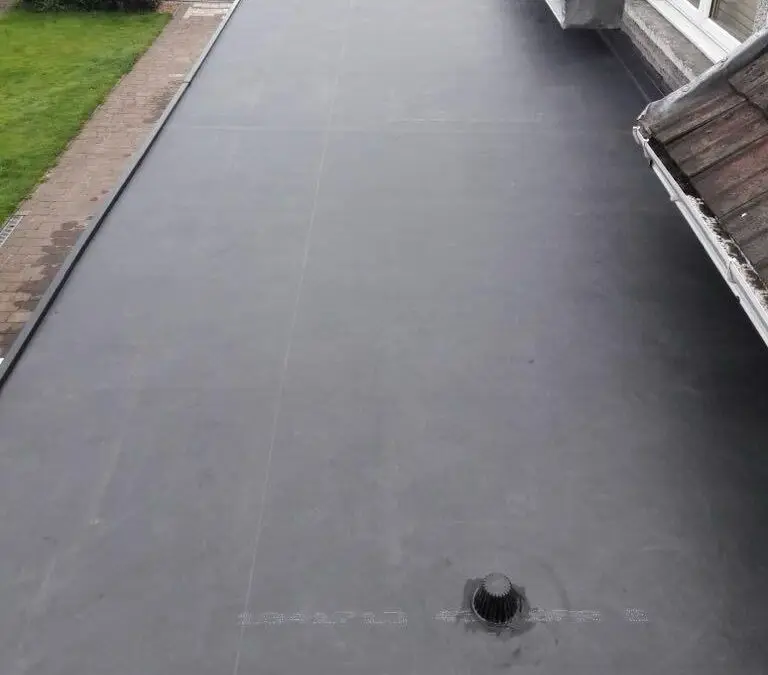
Often 30–50 years — the longest-lived of the three. EPDM is a single-piece rubber membrane with few joins to fail.
That “one big sheet” quality is the secret: on a garage or extension the membrane often goes down with no seams at all in the main field of the roof, and seams are where flat roofs die. It stays flexible through freeze-thaw winters, which suits Scottish conditions well. For most homes, EPDM or GRP is worth the extra over felt because you replace it far less often.
What are the signs a flat roof is failing?
Watch for pooling water, splits, blisters, lifting seams and damp appearing below. Caught early, a flat roof can sometimes be repaired; left too long, it needs replacing.
In Central Scotland it’s worth a quick look at a flat roof twice a year and after big storms — our frequency of heavy rain means ponding shows up quickly, and winter freeze-thaw levers open any split or lifted seam it finds. Moss and debris around outlets are the other local regulars: they dam the water that should be draining away.
Should you repair or replace a flat roof?
If the damage is local and the roof is young, repair it; if faults are spreading and the roof is near the end of its typical lifespan, replacement is usually the better spend.
A patch on a 5-year-old EPDM roof makes sense. Patching a 14-year-old felt roof every winter doesn’t — you’re paying repeatedly to keep a dying roof alive, often while damp quietly gets into the timbers below. A survey tells you which side of the line your roof is on; we’ll give you an honest answer either way.
How much does a flat roof replacement cost?
As a guide, a typical single garage re-roof runs from around £1,200 in felt up to about £3,000 in GRP, with extension-sized roofs above that:
| Roof size | Felt | EPDM | GRP |
|---|---|---|---|
| Garage (approx. 15–20 m²) | £1,200–£2,000 | £1,500–£2,400 | £1,800–£3,000 |
| Extension (approx. 20–40 m²) | £1,800–£3,500 | £2,200–£4,500 | £2,800–£5,500 |
Guide prices from 2025/26 national cost guides; the deck condition, insulation and edge details found at survey set the final figure, confirmed in a fixed written quote.
Frequently asked questions
Can a flat roof be repaired instead of replaced?
Often, yes — caught early, splits, blisters and failed seams can be repaired on all three systems. Once faults are widespread or the deck is wet, replacement is the honest recommendation.
Do flat roofs always leak eventually?
No — that reputation comes from old felt roofs. A properly installed EPDM or GRP roof with decent falls and clear outlets is a genuinely long-term roof, not a ticking clock.
How often should I check my flat roof?
Twice a year and after major storms. Clear leaves and moss from the outlets, and look for ponding, splits or lifted edges — five minutes that can add years.
Which system is best for a garage?
Usually EPDM: garages are typically simple rectangles, so the membrane goes down with minimal seams, at a sensible price, with the longest lifespan of the three.
Flat roof past its best? Call 01236 338876 for a free, no-obligation survey and a clear fixed price, or see our flat roofing in Falkirk service for the EPDM and GRP systems we fit.