
uPVC Fascias & Soffits in Cumbernauld
We replace tired, rotting timber roofline with clean, maintenance-free uPVC fascias, soffits and bargeboards for homes across Cumbernauld and the wider area — quality work from qualified, local roofers.
Get my free quote
Leave three details and we’ll ring you back.
Free, no-obligation survey · Written quote · 10-year guarantee
Open Mon–Sat 9am–5pm
10-Year Guarantee
On all our workmanship
25+ Years
Experience in the trade
Family-Run
A local business you can trust
Fascias and soffits Cumbernauld — guide prices
Cumbernauld has two price bands: the pitched-roof estates, which cost the same as anywhere in Central Scotland, and the 1960s–70s new-town stock, where boxed eaves, flat-roof edge trims and the possibility of asbestos cement add to the work. These are 2026 guide ranges from our own jobs and the national cost guides.
| Job | Typical guide price | What moves it up or down |
|---|---|---|
| Full uPVC fascia replacement, pitched roof, per metre | £80–£150 | Rafter repairs, height, colour |
| Deep fascia with flat-roof edge trim remade, per metre | £110–£200 | Felt drip or EPDM trim, condition of the deck edge |
| Boxed soffit rebuilt with new bearers and vented board, per metre | £120–£220 | Box width, framing replaced, mesh |
| Asbestos cement soffit removal and disposal | £300–£900 per house, plus testing | Quantity, whether a licensed contractor is needed |
| Cap over sound timber on newer estates, per metre | £45–£85 | Timber proven dry at survey |
| Fascias and soffits, 1990s+ estate semi | £1,000–£1,900 | Cap or full boards, gables |
| Full roofline with gutters, 1960s–70s terrace house | £1,600–£3,200 | Boxed eaves, edge trims, asbestos |
| Anthracite or woodgrain foil instead of white | Add about 15–25% to the boards | Foil, matching trims and gutters |
Guide prices only. Asbestos testing and removal, scaffold and flat-roof edge work are itemised separately. You get a fixed written price after a free, no-obligation survey, and that is the figure you pay.
Show my Cumbernauld guide price
Pick the job and the guide range from the table above appears straight away. Leave your details and we’ll ring to book the free survey, then you get a fixed written quote — the guide range is a starting point, not the final price.
What our customers say


Recent F J Allan jobs across Falkirk and Central Scotland
Real jobs by our own team. Ask to see more from your area when we survey.
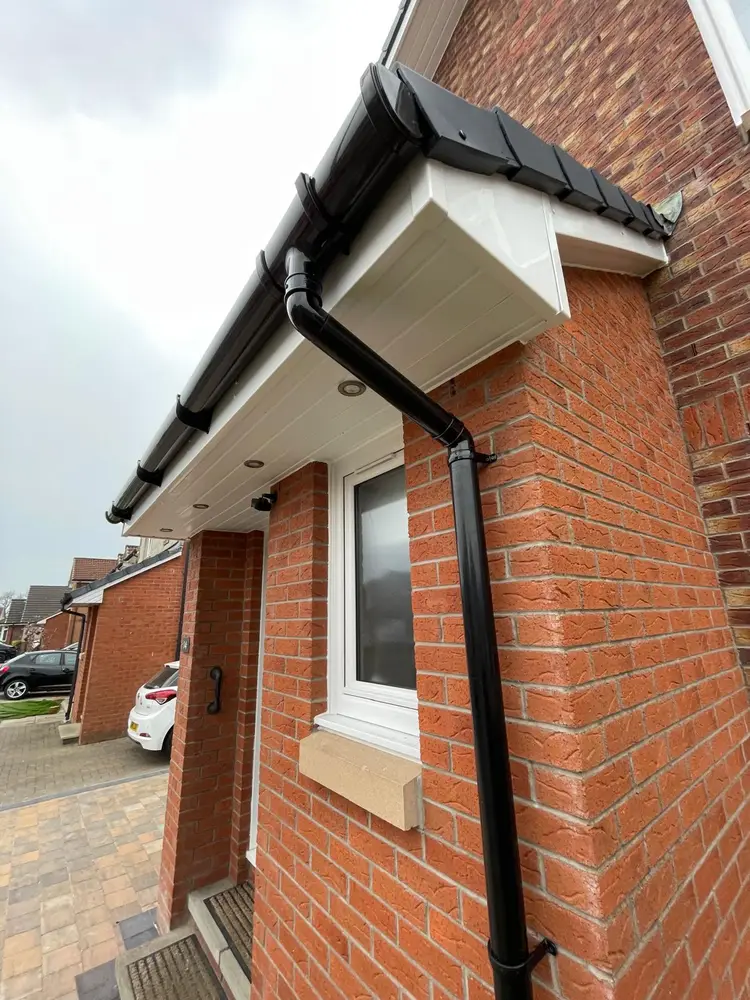
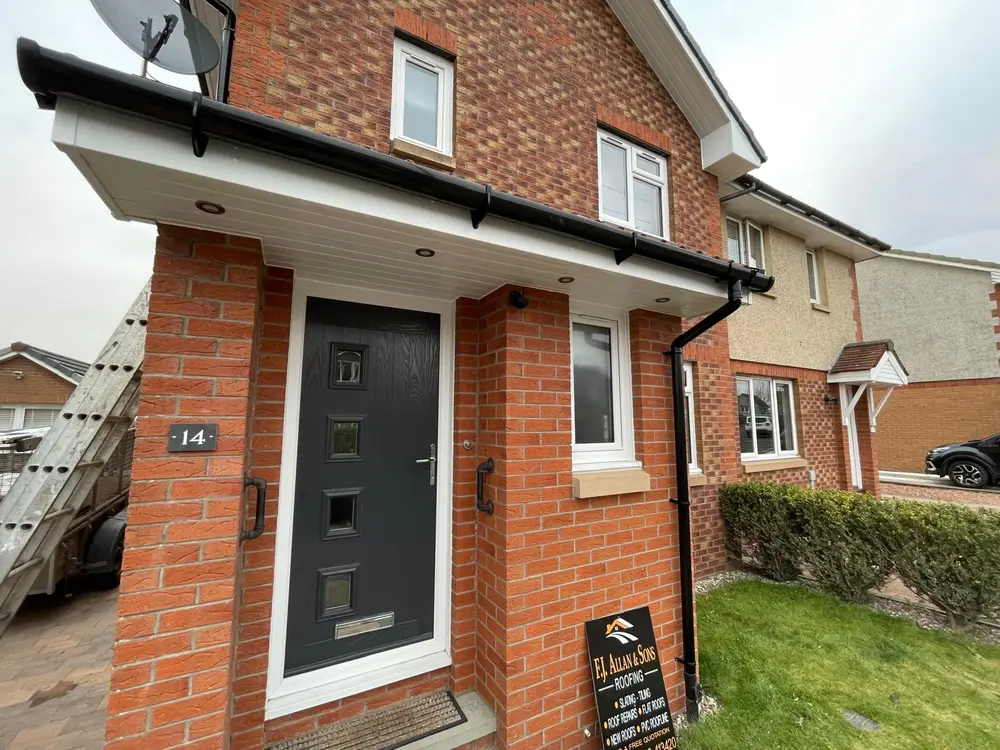
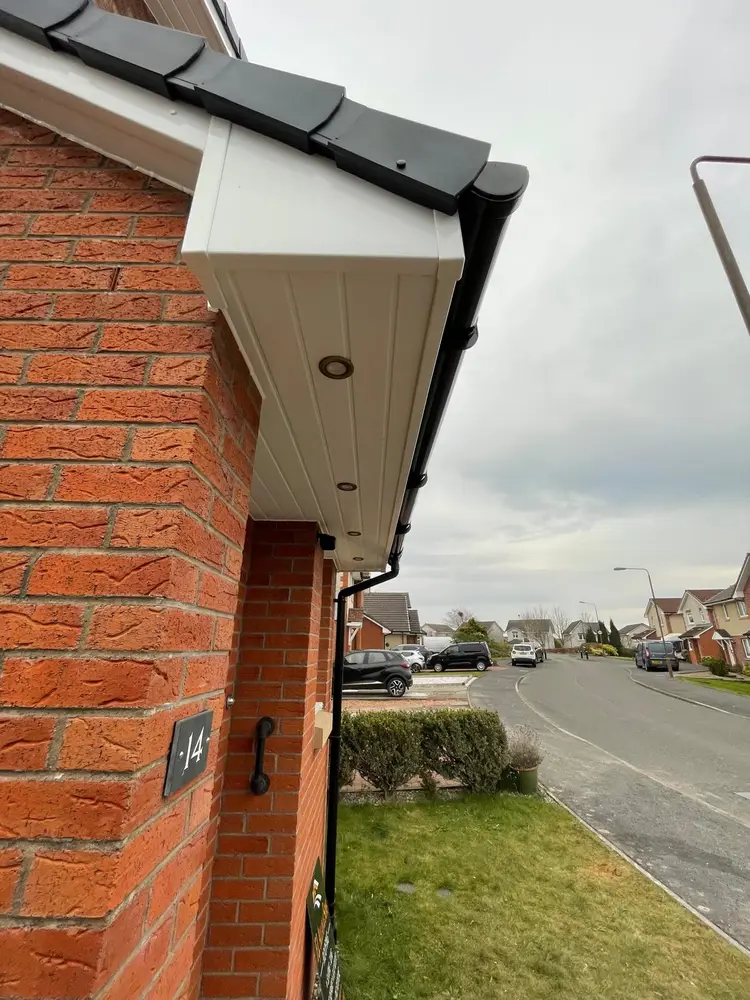
uPVC Fascias & Soffits in Cumbernauld
Cumbernauld has a huge number of new-town-era homes with flat and low-pitch roofs that need specialist attention. We replace tired, rotting timber roofline with clean, maintenance-free uPVC fascias, soffits and bargeboards in Cumbernauld and the surrounding towns and villages, to a standard that lasts through a Scottish winter. As a qualified, insured, family-run team with 25+ years’ experience, we give clear fixed prices, tidy work and a 10-year workmanship guarantee.
For the full detail on our upvc fascias & soffits work, see our main upvc fascias & soffits service.
Our roofline services
Fascias
The board along the roof edge that carries your guttering — replaced in low-maintenance uPVC in your choice of colour.
Soffits
The underside board that closes off the eaves — in vented or solid uPVC to keep the roof breathing and pests out.
Bargeboards
The angled boards at the gable ends — renewed to protect the roof edge and sharpen the look of the house.
Cladding & dry verge
uPVC cladding for gable apex and dry-verge systems for a neat, mortar-free finish that won’t crack and fall.
Signs your roofline needs replacing
Rotten or soft timber
Flaking paint and soft, crumbling boards mean the timber is holding water — and so is the roof edge behind it.
Peeling paint & staining
If you’re repainting the fascias every couple of years, uPVC ends the cycle for good.
Sagging gutters
Gutters pulling away often mean the fascia behind them has rotted and no longer holds the brackets.
Birds & pests in the eaves
Gaps in failed soffits let birds and pests into the roof space — vented uPVC closes them off.
Why Cumbernauld chooses F J Allan
We don’t just cap over old timber and hope — where boards have rotted we replace them, so the new roofline is sound as well as smart. Qualified, insured roofers, tidy work, colour-matched uPVC, and a 10-year workmanship guarantee. 25+ years keeping Forth Valley roofs weathertight.
Areas we cover
As well as Cumbernauld we cover the surrounding area — nearby: Kilsyth · Kirkintilloch · Airdrie. See our full upvc fascias & soffits service, our roof repairs in Cumbernauld, or conservatory roof replacement in Cumbernauld. Not sure if we reach your street? Give us a call.
More about fascias and soffits in Cumbernauld
Open any heading for the detail: what we do here, local roof types, prices, how to check a roofer, and storm claims.
Fascias and soffits in Cumbernauld: a new town with old roofline
Fascias and soffits in Cumbernauld are rarely the plain board-and-gutter arrangement you find in an older town. The 1960s and 70s housing in Kildrum, Seafar, Carbrain, Abronhill and Greenfaulds was designed with flat roofs, monopitches and shallow pitches, and the roofline that goes with them is different: deep timber fascias that double as the edge upstand of a flat roof, boxed eaves with wide horizontal soffits, and long runs of unbroken board across blocks of terraces. Cumbernauld Village and Condorrat have conventional older houses, and the estates built since the 1990s at Craigmarloch, Westerwood and Balloch have standard pitched roofs with uPVC from new.
The new-town roofline is now fifty to sixty years old and was built cheaply, in softwood and sheet materials, for houses that were expected to be modernised long before now. Rot at the ends of the long fascias, soffit boards sagging out of their fixings, and water tracking behind the fascia into the flat-roof deck are the three calls we get most. Each needs a slightly different fix from a standard semi, which is why we survey every house rather than quoting from a photograph.
Boxed soffits, deep fascias and flat-roof edges
A boxed eave is a soffit that runs level from the wall to the fascia with a framed timber box behind it, often 400mm or 600mm wide. Replacing it means new bearers as well as new boards, because the original framing is usually what has rotted and the soffit is fixed to it. On a flat or monopitch roof the fascia also carries the drip edge of the roof covering, so the new uPVC board has to go on before the edge trim is re-dressed over it: on a felt roof that means a new welted drip, on EPDM a new edge trim, and the two are done on the same visit so the joint is watertight. Where the roof covering itself is at the end of its life we say so, because putting new fascia under a failing flat roof is the wrong order of work, and our flat roofing service in Cumbernauld can look at both together.
Asbestos cement soffits on 1960s and 70s houses
Some soffit boards of this era are not timber or plywood but asbestos cement sheet, and occasionally asbestos insulating board. It is grey, hard, slightly rough, and often painted. It is not dangerous while it is left alone and intact, but it must not be cut, drilled or broken up by a roofline fitter who has not identified it. We look for it at survey and treat any doubtful board as asbestos until it is tested. Asbestos cement can be removed whole under non-licensed procedures with the sheets wrapped and consigned to a licensed disposal site, and that cost is itemised on the quote. If a sample shows insulating board rather than cement, removal is licensed work and a licensed contractor does it before we fit the new roofline. Any quote for a 1960s Cumbernauld house that does not mention the soffit material is a quote to be wary of.
Cover it or replace it: our rule on new-town timber
On the pitched-roof estates at Craigmarloch or Westerwood, where the timber under a tired uPVC cap is often dry, a new cap or new full boards are both reasonable and we price whichever suits. On the 1960s and 70s stock we almost always replace, and the reason is structural rather than cosmetic. The deep fascias on a flat-roofed terrace are part of what keeps the roof edge together; capping a rotten one puts a clean face on a board that is losing its grip on the joists, and the flat roof edge behind keeps taking water. Full replacement means the old board and any rotten bearers come off, new treated timber goes in where needed, a full-thickness 18mm uPVC fascia is fixed to it and the roof edge trim is remade over the top. Our quote records which elevations are capped and which are stripped, so a cheaper price can be compared like for like.
Colour on render and brick, airflow and the damp that follows
Cumbernauld’s houses are mostly rendered, roughcast or facing brick, and the windows fitted over the past thirty years are overwhelmingly white uPVC, so white roofline matches most homes. Anthracite grey is the popular choice on the newer estates with grey frames, and black works on dark brick where the owner wants the gutter line to vanish. Woodgrain is rarely appropriate here and we say so. Gutters, downpipes, joint trims and box-end covers all come from the same range so the colour is consistent along a long terrace run.
A boxed eave with no vent is a condensation trap, so new soffits go on with continuous ventilation and insect mesh, and on the flat roofs we check the deck has its own ventilation path where it is a cold-roof design. Eaves combs matter less on a flat roof but on the pitched estates they stop starlings under the first tile. When roofline fails the damp shows as a stain at the top of a bedroom wall or, on flat-roofed houses, as a wet line along the ceiling edge. Our damp and water ingress service in Cumbernauld traces it, our guide to the signs your fascias and soffits need replacing lists what to watch for, and our guttering service in Cumbernauld deals with the box gutters and long runs that come with these roofs.
Hillside terraces, timescales, waste and the guarantee
Seafar, Carbrain and parts of Abronhill are built on slopes with stepped terraces and shared paths, which decides the access. Where there is level ground and a two-storey eave, alloy towers do the job; where the terrace steps down a hillside or the eaves are three storeys above a footpath, we scaffold and the cost is a separate line on the quote. A standard semi takes one to two days; a flat-roofed terrace house with boxed soffits and edge trims takes two to three, and asbestos removal adds a day before we start. Everything we take off leaves the site with us, with asbestos waste consigned separately. Like-for-like roofline needs no building warrant from North Lanarkshire Council. The 10-year workmanship guarantee covers the fixing, sealing and the re-dressed roof edge; the colour of the board is under the manufacturer’s separate guarantee, which we pass on. The full description of methods and finishes is on our fascias and soffits page for Falkirk and Central Scotland.
uPVC Fascias & Soffits FAQs — Cumbernauld
Do you provide upvc fascias & soffits in Cumbernauld?
Yes — we cover Cumbernauld and the surrounding towns and villages. Call for a free, no-obligation quote and a clear fixed price.
How long does uPVC roofline last?
Quality uPVC fascias and soffits last 25–30+ years with virtually no maintenance — no rot, no repainting.
Should I replace fascias when I get a new roof?
It’s the ideal time — the scaffolding’s up and the roof edge is exposed, so doing both together saves money and gives a fully sealed result.
Do you replace the timber or just cap over it?
Where the timber has rotted we replace it. ‘Capping over’ sound timber is fine, but we never hide rot behind new plastic.
Can I have vented soffits?
Yes — vented soffits keep the roof space ventilated, preventing condensation and timber problems in the loft.
What do fascias and soffits cost per metre on a Cumbernauld house?
On a pitched-roof estate house the guide is £80 to £150 per metre for uPVC fascia and £100 to £180 for soffit, or £1,000 to £1,900 for a semi. On 1960s and 70s houses with boxed eaves and flat-roof edge trims the rate rises to £110 to £220 per metre because bearers and edge trims are remade too, so a terrace house with gutters is typically £1,600 to £3,200.
How do I know if my soffits are asbestos?
You cannot tell for certain by looking, but a grey, hard, slightly rough sheet soffit on a house built between the 1950s and early 1980s should be treated as suspect. Do not drill, sand or break it. We identify likely asbestos at survey, arrange a sample test where there is doubt, and price the correct removal and disposal route before any work starts. Timber, plywood and uPVC soffits are not a concern.
Are uPVC, timber or aluminium best on a flat-roofed house?
uPVC in a full-thickness board is the practical choice: it does not rot at the drip edge, which is exactly where the timber originals fail, and it takes an EPDM or felt trim cleanly. Aluminium fascia is used on some commercial flat roofs and lasts longer but costs two to three times as much. Timber needs painting and is the material that has already failed once on these houses.
Should the gutters be replaced at the same time as the fascias?
On the long terrace runs and box gutters of the new-town houses, usually yes, because the old gutter rarely comes off and goes back on without leaking at the joints, and new brackets into new board is the point of the job. If your gutter is recent we refit it. Both options are on the quote and the price difference is modest when the tower is already up.
Can you do just the bargeboards on my Craigmarloch house?
Yes. On the pitched-roof estates the gable bargeboards often weather faster than the fascias, and a bargeboard-only replacement matched to your existing colour is straightforward. We check the dry verge or verge mortar above at the same time and mention anything else we see, but we do not add work to the quote without asking you first.
How long will uPVC last, and will the white go grey?
Branded uPVC roofline fixed to sound timber lasts twenty-five to thirty years and more. It does not go grey of its own accord; a grey film on a Cumbernauld roofline is algae and traffic grime, which washes off with warm soapy water. Yellowing affects only cheap unstabilised boards, and the ones we fit are guaranteed against it by the manufacturer, separately from our 10-year workmanship guarantee.